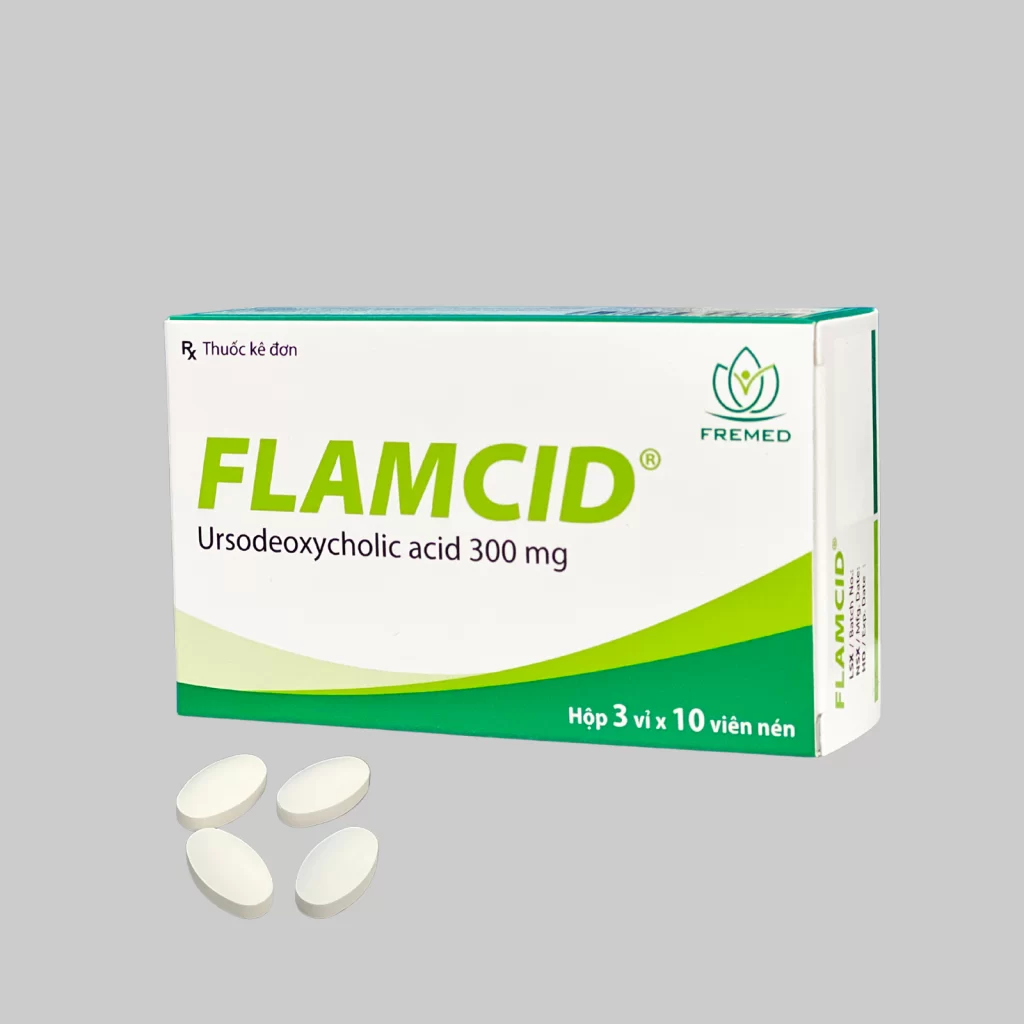
FLAMCID
FLAMCID
Active ingredient: Ursodeoxycholic acid 300 mg.
Dosage form: Tablet.
Packaging: Box of 3 blisters x 10 tablets; Box of 6 blisters x 10 tablets
Expiry date: 36 months.
Posology
The dosage should be calculated based on the patient’s body weight. The calculated dosage should be rounded to the nearest number of tablets.
Dissolving of cholesterol stones
Usual dosage: 8 to 10 mg/kg/day, corresponding to two to three tablets of 300 mg. The daily dose can be administered two or three times after the meals: two tablets should always be taken after the evening meal.
Also a single evening dose can be selected (e.g., a patient of 60 kg, in the evening two tablets of 300 mg). Preferably, this single dose should be taken one hour before bedtime and ± two hours after the evening meal with a glass of milk or a small snack.
The duration of the treatment in order to obtain lysis of the gallstones depends on their size, but is usually not shorter than three to four months. To assess the result of the therapy properly, it is necessary to determine the size of the stones accurately at the start of the treatment and to check this further regularly, for example every six months, by means of a new contrast X-ray recording and/or sonographic recording.
In patients in whom, after six months of treatment with the indicated dosage, the stones are not reduced in size, it is recommended to determine the lithogenic index in the bile by means of a duodenum drainage. When the bile has an index of > 1.0, it is unlikely that a favourable result can be obtained, and it is better to consider a different form of treatment for the gallstones.
Treatment should be continued for three to four months after it is established by means of ultrasound check that the gallstones are completely dissolved. An interruption of the treatment for three to four weeks results in a return to over-saturation of the bile and prolongs the overall duration of the therapy. The interruption of the treatment after the dissolving of the gallstones can be followed by a recurrence.
Primary Biliary Cholangitis
The dosage of ursodeoxycholic acid in primary biliary cholangitis (stages I-III), amounts to 12-15 mg/kg/day, which is equivalent to four to eight tablets of 150 mg, two to four tablets of 300 mg, to be taken in two to three portions during the day.
The dosage of ursodeoxycholic acid in primary biliary cholangitis stage IV and an increase of the serum bilirubin contents (> 40 μg/l), should be in the first instance, only a half of the normal dose
(6 to 8 mg/kg/day). Thereafter, the liver function should be closely monitored for several weeks (once every two weeks for six weeks). If there is no deterioration of the liver function (AF, ALT (SGPT), AST (SGOT), γ-GT, bilirubin) and no increase in itching occurs, the dose may be further increased to the usual level. Moreover, the liver function must then again be closely monitored for several weeks. If again no deterioration of the liver function takes place, the patient may be held at the normal dosage for a long time.
In patients with primary biliary cholangitis stage IV without elevated serum bilirubin, the usual starting dose is allowed to be administered directly. Anyway, here too an accurate control of the liver function should be executed.
The treatment of the primary biliary cholangitis should be regularly assessed on the basis of liver values (laboratory) and clinical findings.
Paediatric population
Children with cystic fibrosis aged 6 years to 18 years.
Treatment of hepatobiliary diseases as a result of cystic fibrosis
20 mg/kg/day divided in two to three divided doses. If necessary, increase to 30 mg/kg/day. This corresponds with two to five tablets of 300 mg to be taken in one or two portions during the day.
Administration
For oral use.
If the patient has difficulty in swallowing because of the size of the tablet, the tablet can be halved if necessary on the dividing score, so that one half tablet can be taken twice directly in sequence.
INDICATIONS
- The dissolution of cholesterol stones in patients:
- with one or more X-ray radiolucent (X-ray negative) gallstones, preferably with a diameter of not more than 2 cm, in a well-functioning gall bladder.
- refusing a surgical procedure or in which surgical intervention is not indicated.
- with whom an oversaturation of cholesterol has been shown by chemical analysis of the bile produced by duodenum drainage.
- Primary Biliary Cholangitis (PBC).
Paediatric population
- Hepatobiliary disorder associated with cystic fibrosis in children aged 6 years to 18 years.
CONTRAINDICATIONS
Ursodeoxycholic acid tablets should not be used in patients with:
- Acute inflammation of the gall bladder or bile ducts.
- Occlusion of the biliary tract (occlusion of the common bile duct or a cystic duct).
- Frequent episodes of biliary colic.
- X-ray radiolucent calcified gallstones.
- Impaired contractility of the gallbladder.
- Hypersensitivity to bile acids or to any of the excipients.
- Active gastric and duodenal ulcers.
Paediatric population
- Unsuccessful portoenterostomy or without recovery of good bile flow in children with biliary atresia.