
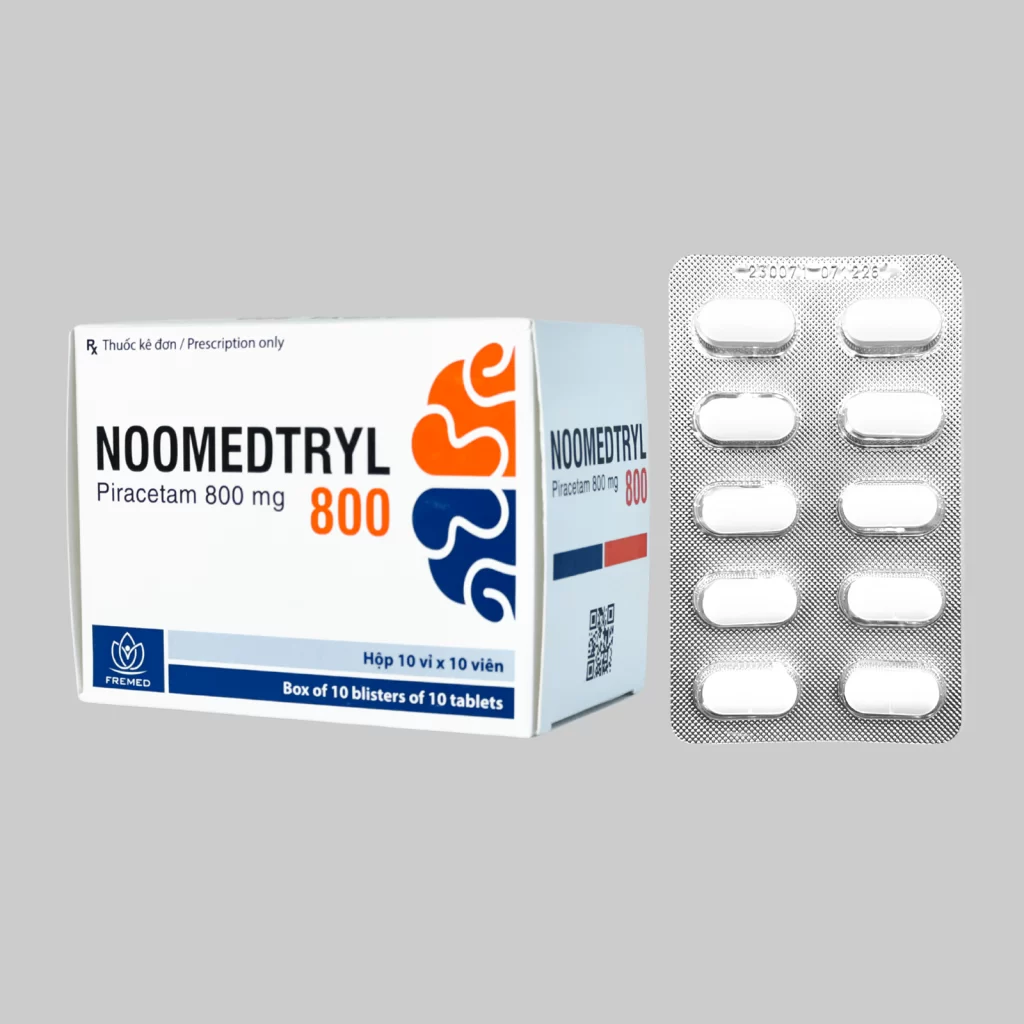
Noomedtryl 800
Noomedtryl 800
Active ingredient: Piracetam 800 mg.
Dosage form: Film-coated tablet.
Packaging: Box of 10 blisters x 10 tablets.
Expiry date: 36 months.
Posology
The daily dosage should begin at 7.2 g increasing by 4.8 g every three to four days up to a maximum of 24 g, divided in two or three doses. Treatment with other anti-myoclonic medicinal products should be maintained at the same dosage. Depending on the clinical benefit obtained, the dosage of other such medicinal products should be reduced, if possible.
Once started, treatment with piracetam should be continued for as long as the original cerebral disease persists. In patients with an acute episode, spontaneous evolution may occur over time and an attempt should be made every 6 months to decrease or discontinue the medicinal treatment. This should be done by reducing the dose of piracetam by 1.2 g every two days (every three or four days in the case of a Lance and Adams syndrome, in order to prevent the possibility of sudden relapse or withdrawal seizures).
Special populations
Elderly
Adjustment of the dose is recommended in elderly patients with compromised renal function (see ‘Dosage adjustment in patients with renal impairment’ below). For long term treatment in the elderly, regular evaluation of the creatinine clearance is required to allow dosage adaptation if needed.
Renal impairment
The daily dose must be individualized according to renal function. Refer to the following table and adjust the dose as indicated. To use this dosing table, an estimate of the patient’s creatinine clearance (Clcr) in ml/min is needed. The Clcr in ml/min may be estimated from serum creatinine (mg/dl) determination using the following formula:
| Group | Creatinine clearance (ml/min) | Dosage and frequency |
| Normal | > 80 | Usual daily dose, divided in 2 to 3 doses |
| Mild | 50 – 79 | 2/3 usual daily dose, divided in 2 or 3 doses |
| Moderate | 30 – 49 | 1/3 usual daily dose, divided in 2 doses |
| Severe | < 30 | 1/6 usual daily dose, 1 single intake |
| End-stage renal disease | — | Contraindicated |
Hepatic impairment
No dose adjustment is needed in patients with solely hepatic impairment. In patients with hepatic impairment and renal impairment, adjustment of dose is recommended (see “Dosage adjustment in patients with renal impairment” above).
Administration
Piracetam should be administered orally, and may be taken with or without food. The tablet(s) should be swallowed with liquid. It is recommended to take the daily dose in two to three sub-doses.
INDICATIONS
Piracetam 800 mg is indicated in adult patients suffering from myoclonus of cortical origin, irrespective of aetiology, and should be used in combination with other anti-myoclonic therapies.
CONTRAINDICATIONS
Hypersensitivity to piracetam or to any of the excipients, or other pyrrolidone derivatives.
Piracetam is contra-indicated in patients with severe renal impairment (renal creatinine clearance of less than 20 ml per minute). It is also contraindicated in patients with cerebral haemorrhage and in patients suffering from Huntington’s Chorea.