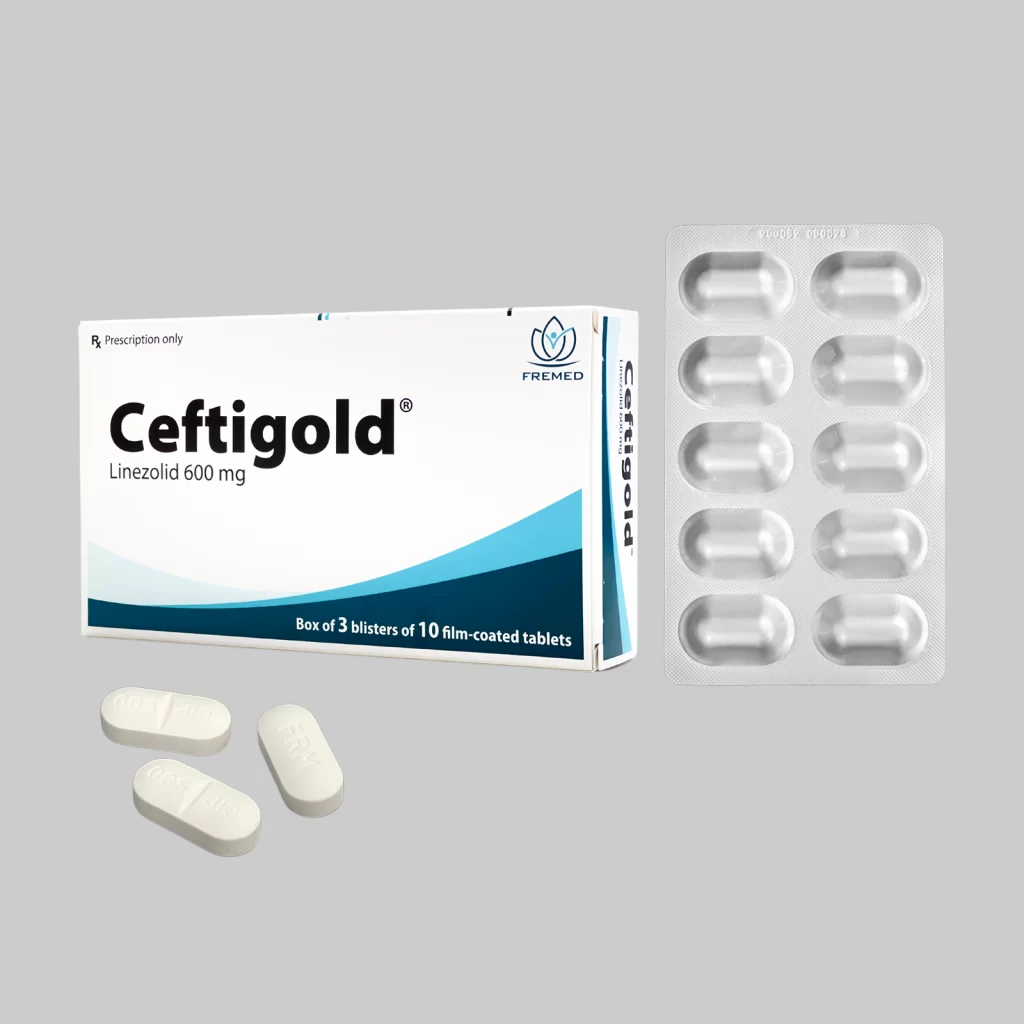
CEFTIGOLD
CEFTIGOLD
Active ingredient: Linezolid 600 mg
Dosage form: Film-coated tablet.
Packaging: Box of 3 blisters x 10 tablets.
Expiry date: 36 months.
Posology
Patients who commence treatment on the parenteral formulation may be switched to either oral presentation such as tablets and suspension without dose adjustment.
Table 1: The dose recommendation for adults and adolescent (> 12 years old)
| Infections (including those associated with concurrent bacteremia) | Dosage and route of administration | Duration of treatment |
| Nosocomial pneumonia | 600 mg IV or orally* q12h | 10-14 Consecutive days |
| Community acquired pneumonia | ||
| Skin and soft tissue infections | 600 mg IV or 400-600 mg orally* q12h | 10-14 Consecutive days |
| Enterococcal infections including vancomycin-resistant Enterococcus strains and including cases associated with concurrent bacteraemia | 600 mg IV or orally* q12h | 14-28 Consecutive days |
* Oral dosing using either Linezolid Tablets or Linezolid for Oral Suspension
Table 2: The dose recommendation for pediatric patients (Birth through 11 Years of Age)
| Infections (including those associated with concurrent bacteremia) | Dosage and route of administration | Duration of treatment |
| Nosocomial pneumonia | 10 mg/kg IV or oral* q8h | 10-14 Consecutive days |
| Community acquired pneumonia | ||
| Skin and soft tissue infections | ||
| Enterococcal infections including vancomycin-resistant Enterococcus strains and including cases associated with concurrent bacteraemia | 10 mg/kg IV or oral* q8h | 14-28 Consecutive days |
Most pre-term neonates < 7 days of age (gestational age < 34 weeks) have lower systemic linezolid clearance values arger AUC values than many full-term neonates and older infants. By 7 days of life, neonatal patients have linezolid clearance values and AUC values are similar to these in full-term neonates and older infants.
* Oral dosing using either Linezolid Tablets or Linezolid for Oral Suspension.
Elderly: No dose adjustment is required.
Renal impairment: No dose adjustment is required (see section Pharmacokinetic properties).
Severe renal impairment (i.e. ClCr < 30 ml/min): No dose adjustment is required. Due to the unknown clinical significance of higher exposure (up to 10-fold) to the two primary metabolites of linezolid in patients with severe renal insufficiency, linezolid should be used with special caution in these patients and only when the anticipated benefit is considered to outweigh the theoretical risk.
As approximately 30% of a linezolid dose is removed during 3 hours of haemodialysis, linezolid should be given after dialysis in patients receiving such treatment. The primary metabolites of linezolid are removed to some extent by haemodialysis, but the concentrations of these metabolites are still very considerably higher following dialysis than those observed in patients with normal renal function or mild to moderate renal insufficiency.
Therefore, linezolid should be used with special caution in patients with severe renal insufficiency who are undergoing dialysis and only when the anticipated benefit is considered to outweigh the theoretical risk.
To date, there is no experience of linezolid administration to patients undergoing continuous ambulatory peritoneal dialysis (CAPD) or alternative treatments for renal failure (other than haemodialysis).
Hepatic impairment: No dose adjustment is required. However, there are limited clinical data and it is recommended that linezolid should be used in such patients only when the anticipated benefit is considered to outweigh the theoretical risk (see sections Pharmacokinetic properties).
Administration
Oral use. The tablets may be taken with or without food.
INDICATIONS
Linezolid is indicated in the treatment of the following infections when known or suspected to be caused by susceptible Gram-positive aerobes and anaerobes including those associated with concurrent bacteremia. Combination therapy may be clinically indicated if the documented of presumptive pathogens include Gram-negative pathogens.
Linezolid is active against Gram-positive bacteria only. Linezolid has no clinical activity against Gram-negative pathogens. Specific Gram-negative therapy is required if a concomitant Gram-negative pathogen is documented or suspected (see section Special warnings and precautions for use and Pharmacodynamic properties).
- Nosocomial pneumonia caused by Staphylococcus aureus(methicillin-susceptible and -resistant strains), or Streptococcus pneumoniae (including multi-drug resistant strains [MDRSP]).
- Community acquired pneumonia caused by Streptococcus pneumoniae(including multi-drug resistant strains [MDRSP]*), including cases with concurrent bacteremia, or Staphylococcus aureus (methicillin-susceptible strains only).
- Skin and soft tissue infections caused by Staphylococcus aureus(methicillin-susceptible only) or Streptococcus pyogenes.
- Enterococcal infections including vancomycin-resistant Enterococcus faeciumand faecalis
*[MDRSP] refers to isolates resistant to two or more of the following antibiotics: penicillin, second-generation cephalosporins, macrolides, tetracycline, and trimethoprim/sulfamethoxazole.
CONTRAINDICATIONS
Linezolid is contraindicated for use in patients who have known hypersensitivity to linezolid or any of the other product components.
Monoamine Oxidase Inhibitors
Linezolid should not be used in patients taking any medicinal product which inhibits monoamine oxidases A or B (e.g. phenelzine, isocarboxazid) or within two weeks of taking any such medicinal product.
Potential Interactions Producing Elevation of Blood Pressure
Unless patients are monitored for potential increases in blood pressure, linezolid should not be administered to patients with uncontrolled hypertension, pheochromocytoma, thyrotoxicosis and/or patients taking any of the following types of medications: directly and indirectly acting sympathomimetic agents (e.g., pseudoephedrine), vasopressive agents (e.g., epinephrine, norepinephrine), dopaminergic agents (e.g., dopamine, dobutamine) (see section Interactions).
Potential Serotonergic Interactions
Unless patients are carefully observed for signs and/or symptoms of serotonin syndrome linezolid should not be administered to patients with carcinoid syndrome and/or patients taking any of the following medications: serotonin re-uptake inhibitors, tricyclic antidepressants, serotonin 5-HTI receptor agonists (triptans), meperidine or buspirone (see section Interactions).